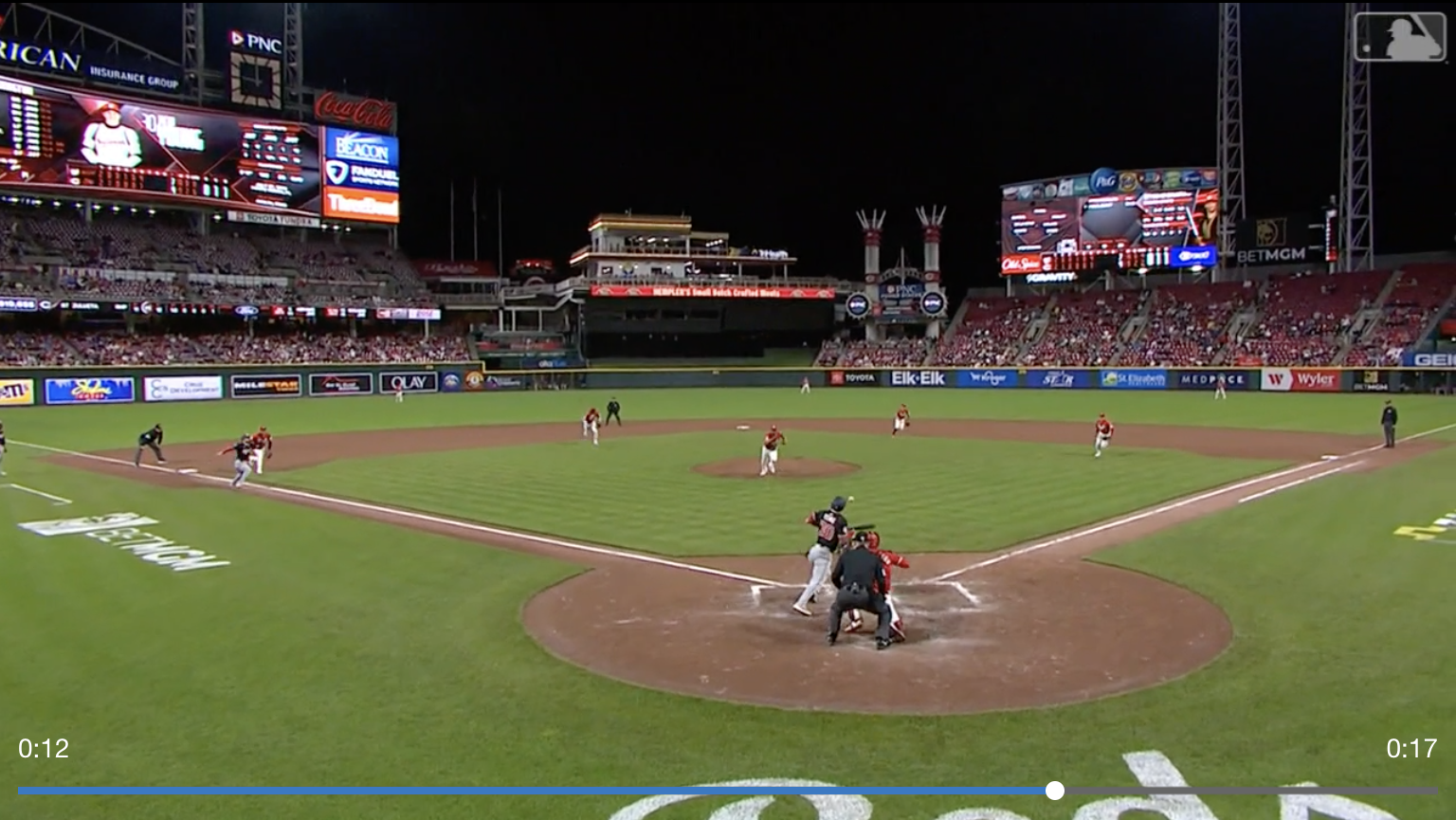
An infield full of Cincinnati Reds players reacts to a sacrifice bunt attempt by Jacob Young (of the Washington Nationals).
A Bunted Ball Goes Fair
When a bunt goes fair, and there are runners on, a whole lot of people are going to spring into action. Usually, the goal for the offense is to produce a "sacrifice"— they want the runners to advance at the cost of the batter. Thus, the batter wants to get the ball into a spot where, once it is fielded, the defense will have only one good option on their hands: to throw the ball to first base. This is harder than it sounds! Bunting is a fairly difficult skill to master, and it’s even harder to pull off when the defense is expecting it, as you will have infielders charging in as the pitch is thrown, along with pitchers throwing pitches that are harder to bunt.
Sometimes, you will hear a bunt referred to as a “squeeze play.” This isn’t a specific type of bunt, just a specific scenario: a bunt that happens when there’s a runner on third base, and the offense really wants to get that runner home. There are a couple of types of squeezes: a “safety squeeze” in which the runner on third doesn’t start running until the ball is bunted, and the “suicide squeeze,” in which the runner breaks for home with the pitch, almost as though they are trying to steal home. You can infer the strategy involved in the names of these plays; on a safety squeeze, the runner has some cover to things go awry. On a suicide squeeze, if the batter doesn’t get the bunt down, that runner is more than likely toast. Or worse, if the bunt is popped up and caught, the runner is almost certainly going to be put out for not tagging up1.